
AP Chemistry: The Hardest Topics and How to Master Them
Treat “hardest” as a question about your own errors, not a universal ranking. Start by finding whether a missed AP Chemistry problem comes from the chemical model, the calculation, or the explanation. Equilibrium, thermodynamics, electrochemistry and kinetics deserve practice, but they are not the whole course.
Choose priorities from evidence
The current College Board course framework assigns Unit 3, Properties of Substances and Mixtures, 18%–22% of the multiple-choice section, and Unit 8, Acids and Bases, 11%–15%. These are exam weightings, not difficulty rankings or free-response weightings. Keep these units in your plan alongside the topics named above.
For each missed problem, record the unit, the exact error and one corrective action. Rebuild a particle model for a conceptual error; write units and mole ratios for a calculation error; connect a claim to chemical evidence for an explanation error. Keep stoichiometry and atomic structure in the review when they are the source of mistakes.
Original practice: identify the limiting reactant
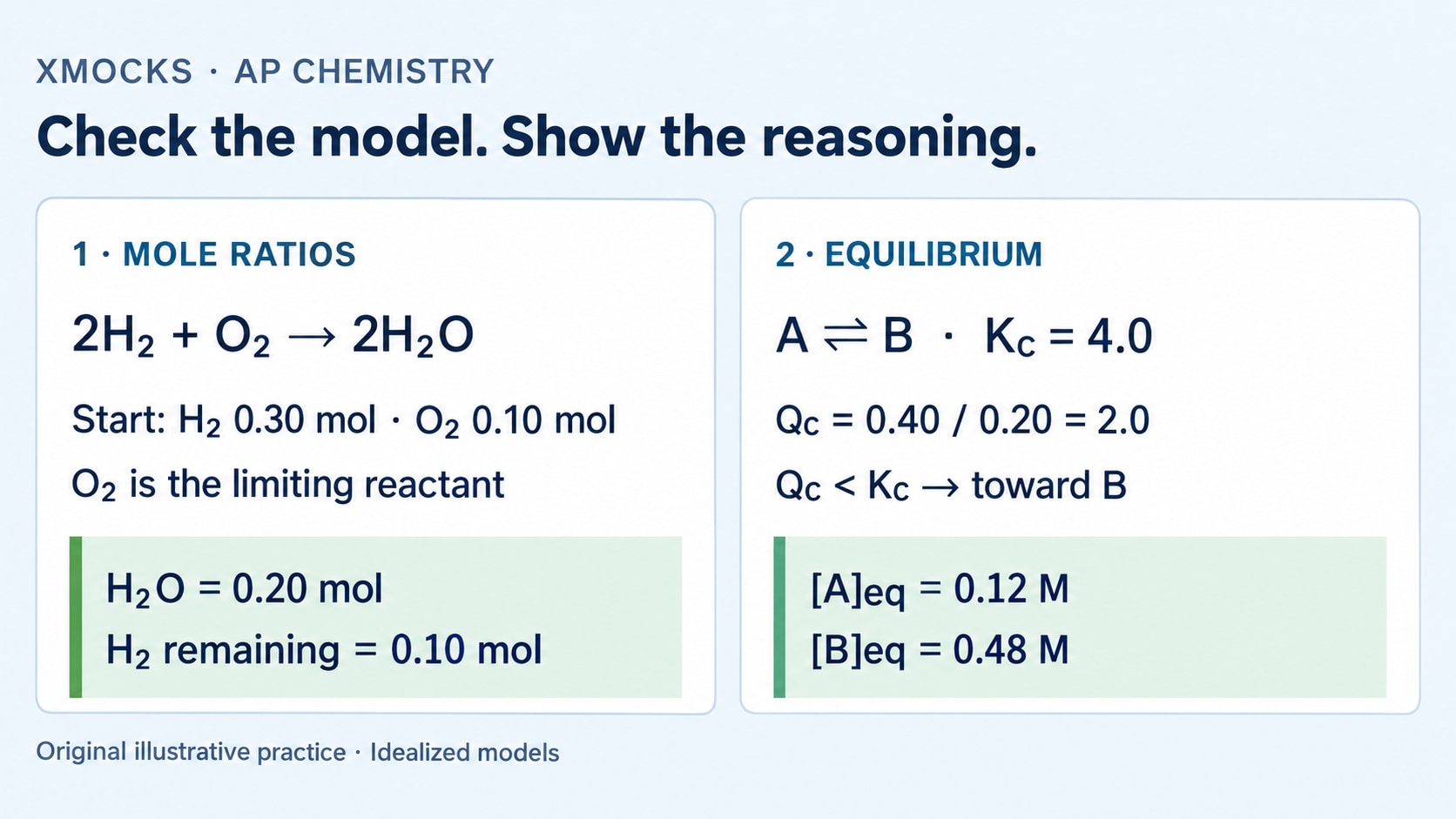
OpenStax explains how balanced coefficients give mole ratios. Consider the idealized complete reaction 2H₂ + O₂ → 2H₂O, starting with 0.30 mol H₂ and 0.10 mol O₂ and no initial water. Which reactant limits the reaction, and how much water can form? This is a paper calculation, not an experiment to perform.
The 0.10 mol O₂ needs 2 × 0.10 = 0.20 mol H₂, less than the 0.30 mol available. Oxygen is limiting. It produces 2 × 0.10 = 0.20 mol H₂O, leaving 0.30 − 0.20 = 0.10 mol H₂. An answer of 0.30 mol water incorrectly assumes all hydrogen can react; 0.10 mol water ignores the 2:1 water-to-oxygen ratio. State the limiting reagent before calculating product.
Original practice: compare Q with K
OpenStax distinguishes the reaction quotient Q from the equilibrium constant K. In an idealized dilute-solution model A(aq) ⇌ B(aq), let Kc = 4.0 at a fixed temperature. In a closed system at fixed volume, the current concentrations are [A] = 0.20 M and [B] = 0.40 M. Predict the net direction before solving for equilibrium.
For this 1:1 reaction, Qc = [B]/[A] = 0.40/0.20 = 2.0. Since Qc < Kc, net reaction proceeds toward B. If x M of A converts to B, (0.40 + x)/(0.20 − x) = 4.0, so 5x = 0.40 and x = 0.080 M. The equilibrium values are [A] = 0.12 M and [B] = 0.48 M; their ratio is 4.0 and their sum remains 0.60 M. Inverting the expression gives the wrong quotient. K describes equilibrium composition, not how quickly it is reached.
Practice the explanation and the lab reasoning
After the calculation, explain what each number means in the chemical model. For a proposed investigation, identify what is varied, what is measured and which comparison would support the claim. Practice reading a graph, describing an uncertainty and explaining how the data support a conclusion. A numerical answer alone does not show your reasoning.
Use official released free-response questions and scoring guidance linked from the exam page to check the explanation, not just the final number. Simulations can supplement conceptual practice; follow your course’s actual laboratory and safety requirements. Do not treat a virtual exercise as permission to perform an unsupervised chemical experiment.
Prepare for the current exam medium
As checked on October 26, 2026, the official exam page describes a hybrid digital format: multiple-choice work and free-response prompts use Bluebook, while free-response answers are handwritten in paper booklets. Practice moving from an on-screen prompt to a clear handwritten calculation and explanation. Recheck the official page before your exam.
Choose a short set of problems across your identified weak units, then compare the work with the relevant scoring guidance. Write down the first incorrect step, repair it and attempt a similar problem without looking at the solution. Use this evidence to choose the next practice topic instead of assuming the same topic is hardest for everyone.
Take the next step
Try the two original examples before reading their solutions, then name the error each wrong approach would create. For related lessons, visit the XMocks AP archive or try XMocks.