SAT Math: Successive Percent Changes Need a New Base
For successive percent changes, multiply by a factor for each step and name the base each percentage uses. An increase of 20% followed by a decrease of 20% leaves 96% of a positive starting value, so the net result is a 4% decrease.
College Board lists percentages in SAT Problem-Solving and Data Analysis. Its Math Student Question Bank guide includes the relationship between percent changes and growth factors. The fictional examples below are original practice, not official SAT questions.
Turn each change into a multiplier
For a positive starting amount x, increasing it by p% gives x(1 + p/100). Decreasing it by q% gives x(1 − q/100), with 0 ≤ q ≤ 100 in these nonnegative-price examples. Thus a 20% increase uses 1.20, and a 20% decrease uses 0.80.
To find the overall percent change, calculate (final − original)/original × 100%, with a positive original amount. A negative result indicates a decrease. OpenStax explains percent increase and decrease using the original amount as the comparison base. The same base must be used when reporting the overall change.
Worked example: follow the changing base
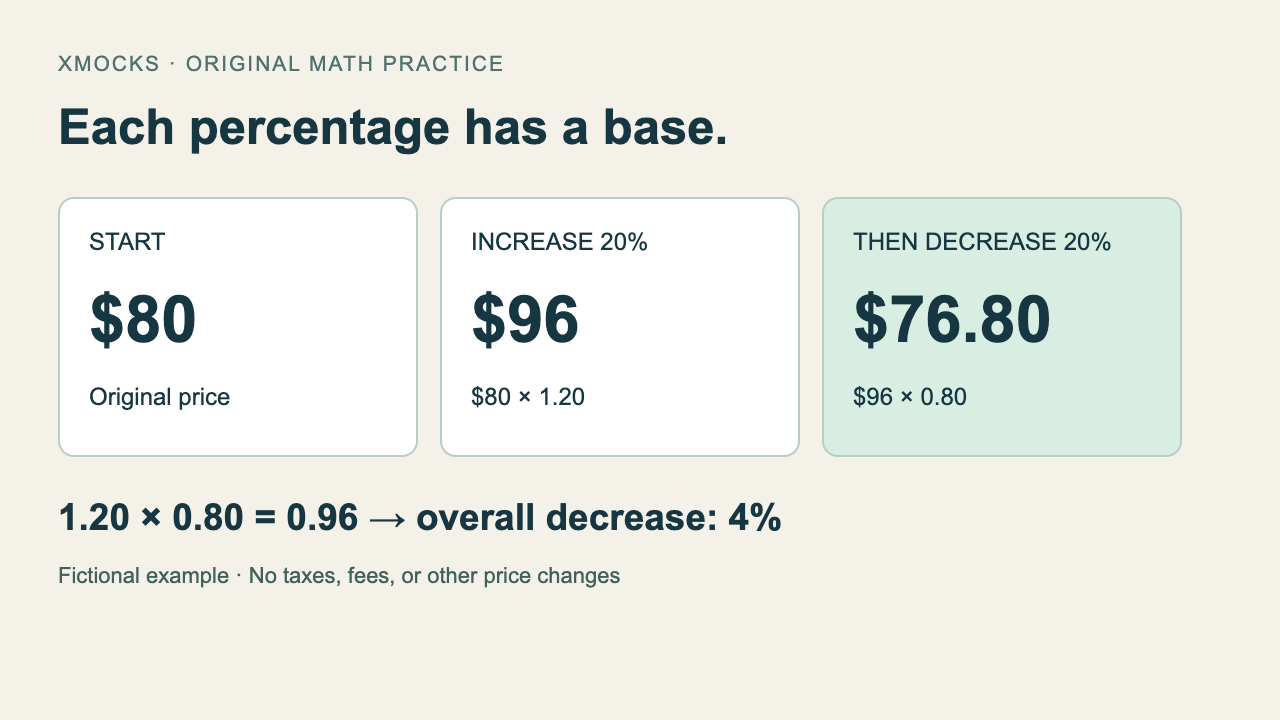
A fictional workshop pass costs $80. Its price increases by 20%, then the new price is discounted by 20%. There are no taxes, fees, or other changes. What is the final price and the overall percent change?
First step: $80 × 1.20 = $96. The increase is $16 because 20% is applied to $80. Second step: $96 × 0.80 = $76.80. The discount is $19.20 because the second 20% is applied to $96.
The final price is $76.80. The overall change is ($76.80 − $80)/$80 × 100% = −4%, which means a 4% decrease. Equivalently, 1.20 × 0.80 = 0.96, so the final price is 96% of the original.
Diagnose each answer choice
For the final-price question, consider these original choices: A. $64; B. $76.80; C. $80; D. $96. Choice B is correct.
Choice A applies only a 20% discount to the original $80 and omits the increase. Choice C treats +20% and −20% as canceling despite their different bases. Choice D stops after the increase and omits the discount. Tracking both intermediate amounts explains each error.
Practice: a small increase can remain
A fictional supply kit starts at $125. Its price rises by 12%, then the new price falls by 10%. With no other charges, find the final price and the overall percent change before reading the solution.
The first price is $125 × 1.12 = $140. The final price is $140 × 0.90 = $126. The overall increase is $1/$125 × 100% = 0.8%. Subtracting 10 from 12 would give 2%, but that ignores the changed base. The combined factor 1.12 × 0.90 = 1.008 confirms the 0.8% increase.
Reverse a discount by dividing
A different fictional item costs $90 after a 25% discount, with no other price changes. If x is its positive original price, 0.75x = 90, so x = 90/0.75 = $120. Adding 25% to $90 gives $112.50 and does not undo the discount, because that 25% would use the smaller base.
Check by applying the original operation: $120 × 0.75 = $90. When working backward through several nonzero factors, divide by those factors. A 100% decrease gives a factor of zero, so a zero final amount cannot identify a unique original amount by division.
Write the base before calculating
For each step, write the current amount and its multiplier. Keep exact decimals until any rounding requested by the question. At the end, distinguish the final amount from the percent change relative to the original amount. A change from 40% to 50% is 10 percentage points, but a 25% relative increase: (50 − 40)/40 × 100% = 25%.
For official practice, use College Board’s Math Student Question Bank guide to identify the percentages skill. For more XMocks lessons, visit the SAT preparation archive. This independent lesson makes no promise of a score increase.