
AP Human Geography Study Guide: Key Concepts and Examples
A useful AP Human Geography plan connects concepts to maps, data and geographic scale. Include population and migration, agriculture, urban patterns, and development alongside cultural and political geography; a topic-name checklist alone does not show that you can apply them.
The fully digital Bluebook exam has 60 multiple-choice questions in 60 minutes and three free-response questions in 75 minutes, each section worth 50%. The free-response questions use no stimulus, one stimulus, and two stimuli respectively. College Board exam format and current CED.
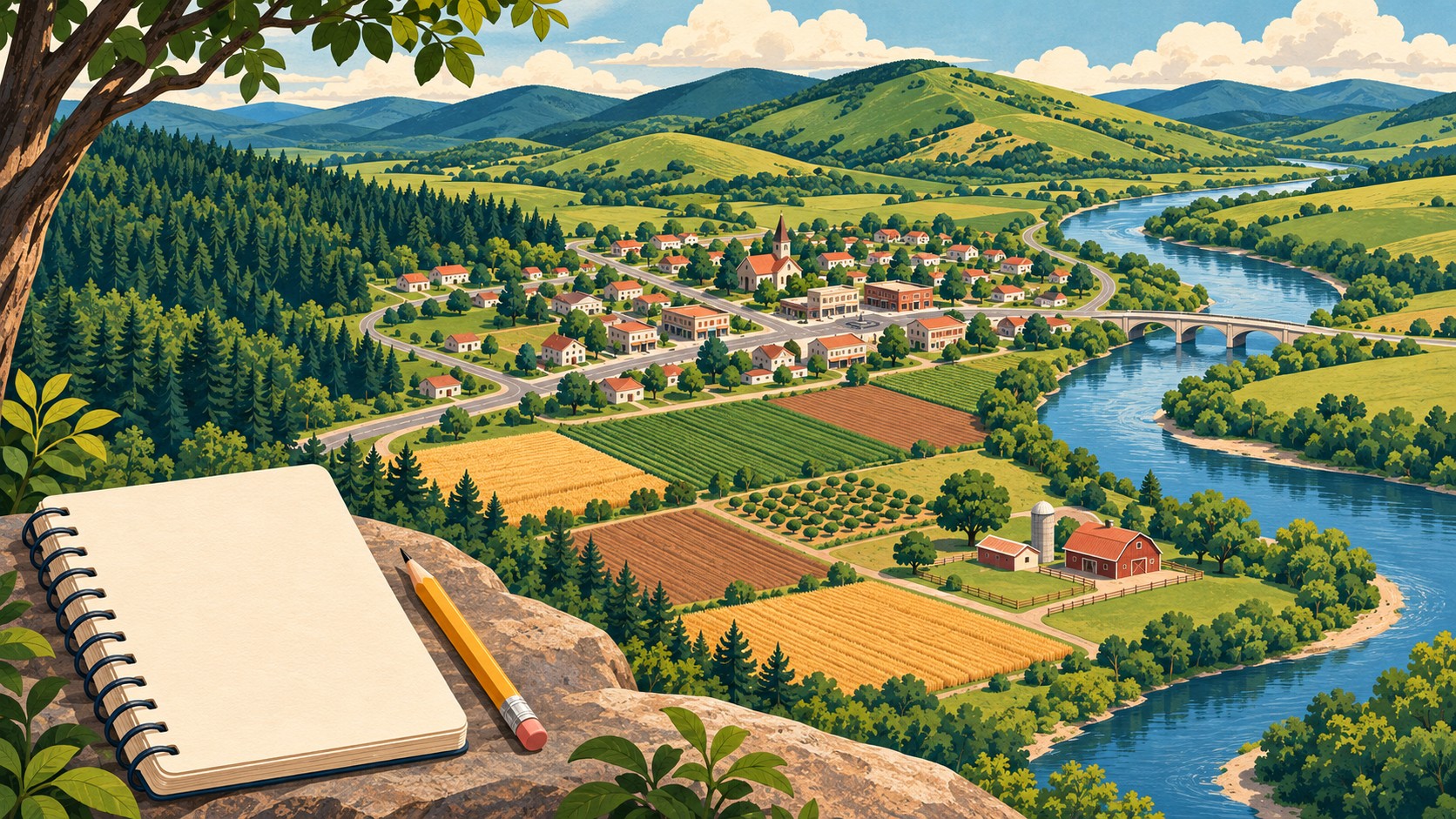
AP Human Geography examines how humans create meaning in places and organize space. Master cultural systems, political territories, economic development patterns, and human-environment interactions. Success requires understanding scale—how local, national, and global processes interact.
Human Geography Examples and Non-Examples: Classify the Question
Start with what the question asks you to explain. A human-geography question investigates people, places, spatial patterns, or human–environment relationships. A physical process may be important evidence, but mentioning a river or mountain does not by itself decide the category. The official course emphasizes geographic concepts, spatial relationships, data and scale; use the current course framework to connect each exercise to a skill.
Original practice 1: “How does river velocity affect the size of sediment deposited downstream?” This question focuses on a physical process. It is a non-example of a human-geography investigation as written. It supplies no question about settlement, land use, people or their relationship with that process.
Original practice 2: “Why are new warehouses concentrated near the highway interchange rather than evenly distributed across the city?” This is a human-geography question about the spatial pattern of economic activity. A map can establish the concentration; explanations about access, land costs or zoning require additional evidence. The pattern alone does not prove a cause.
Original practice 3: “How do flood-risk maps and household income relate to the location of new housing?” This is a human–environment investigation. Flooding is physical, but the question concerns housing decisions and the distribution of people and exposure. Do not assume that a correlation proves why households live there, or that all households have the same choices.
Original practice 4: “What is the definition of migration?” This checks vocabulary. To turn it into a geographic investigation, ask how an identified migration flow changes population patterns at local and national scales. Then specify the time period, places and data needed. The district example later in this guide shows why the scale matters.
A Four-Step Answer Check
For an unfamiliar example, write four short notes: (1) the phenomenon being studied, (2) the spatial pattern or relationship, (3) the scale, and (4) evidence needed to evaluate an explanation. If you cannot identify a spatial question yet, rewrite it before collecting facts. These original exercises illustrate reasoning; they are not copied College Board questions or official scoring rubrics.
Choose the Next Practice Task
Use the current official course outline to identify a concept you cannot yet apply. Complete one related task, then record the part of your explanation that needs better evidence. You can browse the AP article archive or inspect the currently available XMocks practice catalog for a matching next task. Check the listed subject and access conditions rather than assuming every resource covers every course.
Cultural Geography and Identity
Use the course’s culture and diffusion topics to investigate a particular place. Identify a cultural practice, trace the evidence for its distribution, and compare possible explanations for how it spread. Avoid treating a social group as culturally uniform.
Cultural Concepts:
- Review the course definitions of culture and diffusion.
- Compare a language-distribution map with a cited explanation.
- Examine an identified cultural landscape.
- Ask which evidence supports a claim about identity or inequality.
- Compare local patterns with broader patterns without assuming they are identical.
Political Organization of Space
For political-geography practice, distinguish the terms in a question before applying them. Use a sourced example to examine boundaries, territoriality, sovereignty, or devolution. If you propose an explanation for conflict, identify supporting evidence and alternative explanations.
Political Geography Topics:
- States, nations, and nation-states
- Boundaries and border disputes
- Geopolitics and power relationships
- Supranational organizations
- Devolution and regional movements
Economic Systems and Development
Compare changes in economic sectors across two places using identified data and the course’s development models. Ask what each model explains and what it leaves out. Do not assume that every country follows one sequence or that a single factor explains a development difference.
Economic Geography Concepts:
- Check how an assigned development measure is defined before comparing values.
- Apply a course development model and identify its limitations.
- Examine evidence for a proposed historical explanation.
- Trace an example of trade or a supply chain using cited sources.
- Connect an agricultural land-use pattern to a specific geographic question.
Urban Geography
For an urban-geography exercise, compare maps or data about settlement, infrastructure, or land use. Identify the scale and date of each source. Describe the pattern first, then explain which additional evidence would help evaluate possible reasons for the difference.
Human-Environment Interactions
For a human–environment exercise, choose a defined place and question. Examine evidence about an environmental change, human activity, and possible responses. Identify whose perspective and which time period the evidence represents. Treat a proposed explanation as a claim to test, not a conclusion established by the topic alone.
Environmental Topics:
- Practice interpreting population data and the demographic-transition model.
- Use an assigned example to examine resource use or sustainability.
- Connect agriculture or food systems to a geographic pattern.
- If discussing environmental inequality, supply evidence for the specific place and population.
- If using a hazard example, distinguish observed exposure from an unsupported claim about consequences.
Applying Geographical Concepts
Geography emphasizes scale analysis—understanding how processes operate at different scales (local, national, global) and interact. Practice applying concepts like diffusion, core-periphery, cultural regions, and power relationships to diverse phenomena.
2027 Exam Strategy
Human Geography questions test conceptual understanding through multiple-choice and free-response. Free-response tasks use geographic situations or scenarios and ask students to apply concepts, processes, or models. Strong preparation involves engaging with contemporary global issues geographically.
Study Approach:
- Develop case study knowledge for each topic
- Understand how concepts apply across regions
- Connect political, economic, and cultural factors
- Analyze maps and spatial patterns
- Consider how scale shapes processes and outcomes
Check the 2026–27 Course Requirements
The official course also includes Thinking Geographically and Population and Migration Patterns and Processes. Treat migration and population analysis as substantive study areas, not just an environmental-topic bullet. Use the current seven-unit course outline to check coverage.
Example: Explain the Reasoning
Original scale-analysis practice, using invented data: a country consists of Districts A and B. Exactly 100 residents move from B to A, and no other migration occurs. A gains 100 residents through migration, B loses 100, and national net migration is zero: 100 + (−100) = 0. Local populations change through this internal movement despite the unchanged national migration total. “No migration occurred” is incorrect because 100 residents moved. Births and deaths are separate components of population change and are not supplied in this example.