SAT Math: Check Extraneous Solutions Before You Answer
To reject an extraneous solution, substitute each candidate into the original equation and check its domain. A value that works only after squaring or cancelling is not a solution to the original problem.
College Board’s Advanced Math overview includes rational, radical and other nonlinear equations. This guide focuses on checking solutions, with original practice examples rather than official SAT questions.
Write the restriction before the algebra
For real-number equations, an expression under a square root must be nonnegative, and a denominator cannot be zero. The square-root symbol means the nonnegative root. Write these restrictions next to the original equation so they survive later simplification.
Squaring can lose sign information: 2² and (−2)² are equal even though 2 and −2 are not. Paul’s Online Notes on radical equations explains why candidate answers must be checked in the starting equation. The examples below show the check explicitly.
Example 1: a negative candidate that fails
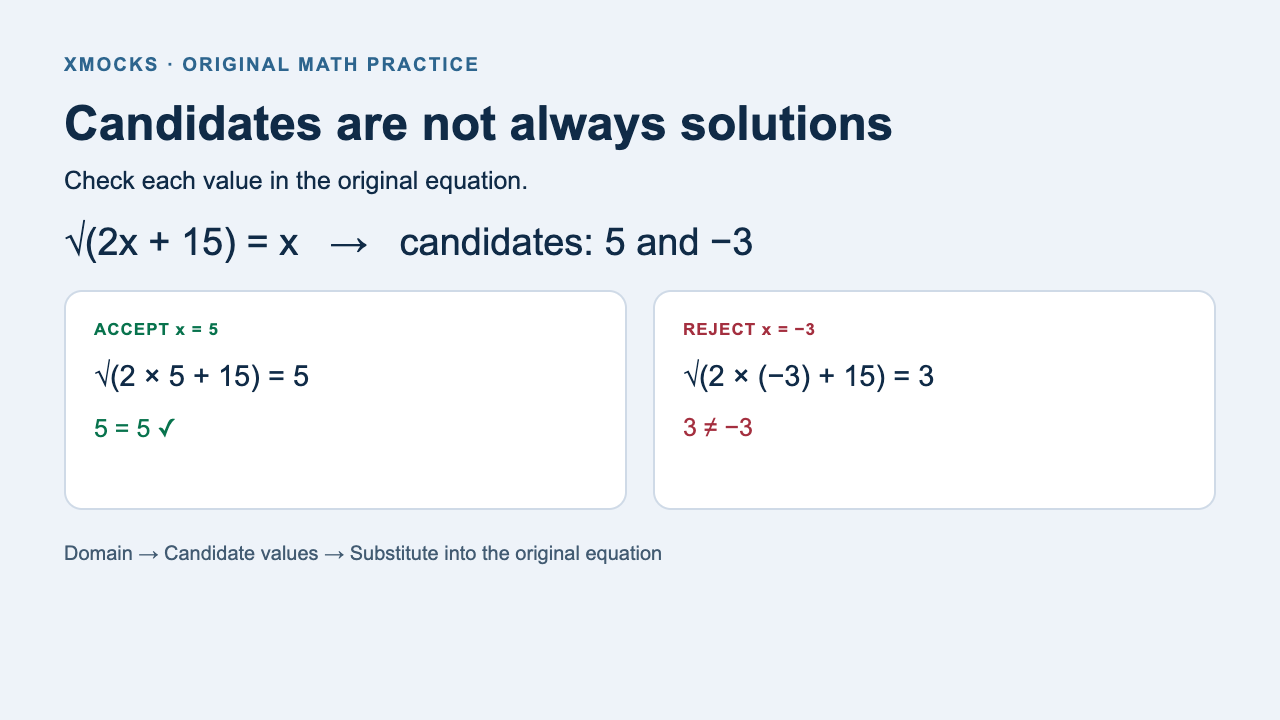
Solve √(2x + 15) = x over the real numbers. The radical requires x ≥ −7.5; because the left side is nonnegative, any solution must also satisfy x ≥ 0.
Squaring gives 2x + 15 = x². Rearrange and factor: x² − 2x − 15 = (x − 5)(x + 3) = 0. The resulting candidates are 5 and −3.
Check x = 5 in the original equation: √(2 × 5 + 15) = √25 = 5. It works. Check x = −3: √(2 × (−3) + 15) = √9 = 3, which is not −3. The only solution is x = 5.
The value −3 is an extraneous candidate, not an arithmetic mistake in the factoring. Squaring created an equation that also accepts the wrong sign. Checking only x² − 2x − 15 = 0 would miss the problem.
Example 2: cancellation does not restore an excluded value
Solve (x² − 9)/(x − 3) = 6. First record x ≠ 3, because the original denominator cannot be zero.
Factor the numerator: (x − 3)(x + 3)/(x − 3) = 6. For x ≠ 3, cancellation gives x + 3 = 6, whose candidate is x = 3. That value was excluded at the start: substituting it into the original fraction gives 0/0, which is undefined. There is no solution.
Compare the nearby problem (x² − 9)/(x − 3) = 7. The same restriction applies, but x + 3 = 7 gives x = 4. The original fraction is (16 − 9)/(4 − 3) = 7, so 4 is valid. A denominator in an equation does not mean every candidate must be rejected.
Try one before reading the check
Solve √(2x + 3) = x. What are the candidates, and which satisfy the original equation?
Squaring gives x² − 2x − 3 = (x − 3)(x + 1) = 0, so the candidates are 3 and −1. Substitution gives √9 = 3 for the first, but √1 = 1 ≠ −1 for the second. The solution set is {3}.
Use a short verification routine
Record the original restrictions, solve for candidates, and substitute into the original equation. Then answer exactly what the question asks: a value, a count of solutions, or a solution set. Do not report two solutions just because a transformed quadratic has two roots.
For more practice, use College Board’s Math Student Question Bank to select nonlinear-equation work. In your notes, record the rejected value and the specific reason: wrong sign, zero denominator or another failed original condition. Treat this as a checking habit, not a promised score increase.
For broader reading, visit our SAT preparation archive. This lesson is independently written by XMocks and is not an official College Board practice item.