
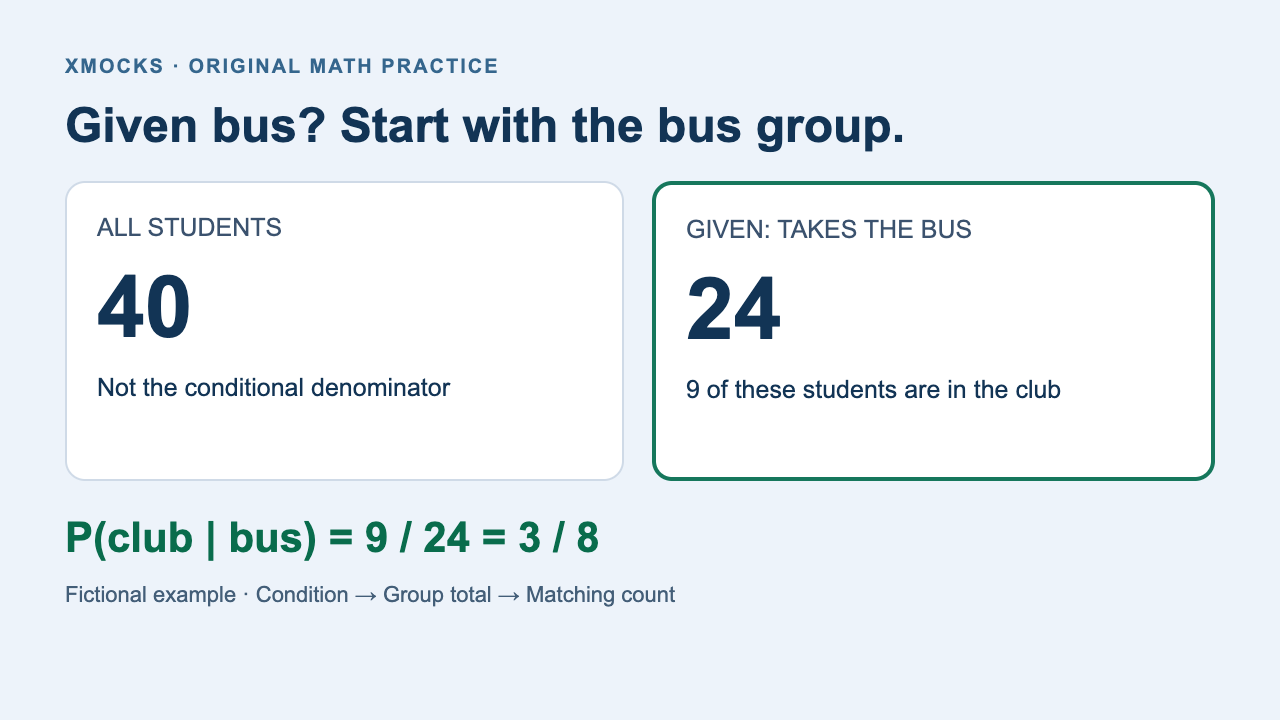
SAT Math: Conditional Probability Starts with the Given Group
For conditional probability in a two-way table, first restrict the group to the condition stated after “given.” Your denominator is that group’s total. Your numerator counts the members of that group who also meet the requested condition.
College Board’s Problem-Solving and Data Analysis overview includes probability and conditional probability. This lesson uses an original fictional table to practice choosing the denominator; it is not an official SAT question.
Start with one table and check its totals
In this fictional example, 40 students are classified by their usual travel method and coding-club membership. Every student uses exactly one of the two listed travel methods and is either in the club or not. A student is selected uniformly at random from these 40 students.
| Travel | In club | Not in club | Total |
|---|---|---|---|
| Bus | 9 | 15 | 24 |
| Walk | 7 | 9 | 16 |
| Total | 16 | 24 | 40 |
The bus row totals 9 + 15 = 24. The walk row totals 7 + 9 = 16. The club column totals 9 + 7 = 16, and the grand total is 24 + 16 = 40. These checks make sure you are reading counts consistently.
Given bus: use 24, not 40
Question: What is the probability that the selected student is in the coding club, given that the student takes the bus?
The condition limits the group to the 24 bus riders. Of those 24 students, 9 are in the club. Therefore P(club | bus) = 9/24 = 3/8.
The vertical bar in P(club | bus) means “given.” Read the event after the bar first to identify the group. The probability notes hosted by Stanford define conditional probability as P(A | B) = P(A and B)/P(B), provided P(B) is not zero. In an equally likely count table, this becomes the matching intersection count divided by the given-group count.
Explain the tempting wrong denominators
For the bus-given question, compare these original answer choices: A. 9/40; B. 9/24; C. 9/16; D. 16/40. Choice B is correct.
Choice A uses all 40 students and answers the joint question “bus and club.” Choice C uses the 16 club members and reverses the condition. Choice D is the probability of club membership among all students, without the bus condition. A fraction can be valid for a different question and still be wrong here.
Reverse the condition and the answer changes
Now ask for P(bus | club). The given group is the 16 club members, and 9 of them take the bus, so P(bus | club) = 9/16. The shared count is still 9, but the denominator changes from 24 to 16. The two conditional probabilities are not interchangeable.
Try a new question from the same table
What is P(walk | club)? Identify the denominator before looking at the answer.
There are 16 club members, and 7 walk. Therefore P(walk | club) = 7/16. Using 7/40 would answer “walk and club”; using 7/16 answers the requested conditional question.
For a second check, P(not in club | bus) = 15/24 = 5/8. Within the bus group, club and not-in-club cover all possibilities, so 3/8 + 5/8 = 1.
Use a short table-reading routine
Identify the given group, check that its count is positive, find the matching intersection, and divide. If the given group has probability zero, the ordinary conditional-probability formula is undefined; do not divide by zero or invent a new denominator.
For official practice, use College Board’s Math Student Question Bank and choose probability and conditional probability. In your notes, write the denominator in words before calculating. This is a checking routine, not a promised score increase.
More lessons are available in our SAT preparation archive. This original XMocks lesson is independent of College Board.