An SAT/ACT Study Schedule by High School Grade
Build your SAT or ACT schedule around your current skills, school workload and the test dates your colleges will accept. Use your grade to choose a starting point, then adjust the plan using practice results. A ninth grader exploring the tests and a senior deciding on a retake need different next steps.
Start with a baseline and a workable calendar
College Board’s study-plan guidance recommends identifying strengths and challenge areas, using practice results to target review, and choosing activities that fit your available time. For the SAT, its Bluebook practice tests connect results to My Practice. ACT also provides official digital and paper practice resources. Use materials that match the test program you plan to take.
Before adding study sessions, put school assignments, activities, sleep and family commitments on your calendar. Mark the time you can reliably protect. Choose a specific task for each session, such as reviewing linear equations or checking evidence in a reading passage. Leave room to review answers; finishing questions is only part of the work.
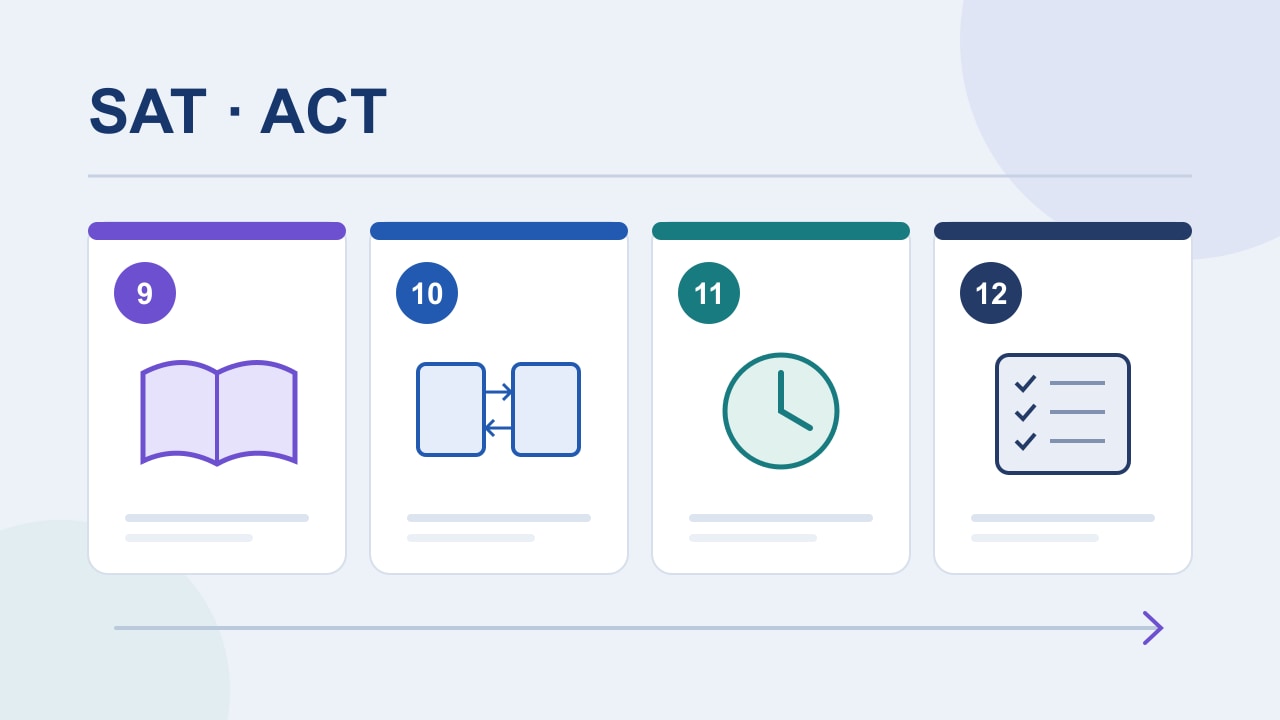
Grade 9: build foundations and explore when useful
Prioritize your current math and English coursework. Keep a record of concepts that remain confusing after class, and ask for help while those topics are still fresh. Read material that requires you to follow an argument and explain its evidence.
If you want to explore a test, try a small set of current sample questions or look at its interface. Use that experience to identify unfamiliar skills. You can keep this light and fit it around school; a grade label alone should not decide whether you are ready for a practice task.
Grade 10: compare the tests and find specific gaps
Explore current official SAT and ACT practice before committing to one preparation path. Compare your comfort with the questions, pacing and review process, and inspect each score report on its own terms. Our current SAT-versus-ACT comparison explains the format differences to consider.
Choose one or two recurring gaps from your work. An algebra concept that is not yet secure needs a different session from a reading question you missed because you overlooked a qualification. Plan a short review, try new questions, and check whether you can explain the reasoning afterward.
Grade 11: work backward from a suitable test date
Choose a possible first test date using College Board’s current SAT calendar or ACT’s registration resources. Confirm the registration requirements for your location and program. Then build a weekly routine you can sustain alongside school. Check each target college’s testing and score-submission instructions when planning how the result will be used.
Schedule a baseline test, targeted review sessions and later checkpoints. Use the timing and conditions applicable to your actual test and accommodations for a full simulation. Reserve a separate review block afterward. Between checkpoints, use your errors to select the skills to practice next.
Grade 12: check deadlines before planning a retake
For each college, write down the testing requirement, latest accepted test date, score-submission deadline and superscoring instructions. Confirm these on the college’s own admissions site. Avoid assigning every senior the same final testing month or assuming that every institution combines section scores.
Consider a retake when it serves your application plan and you have time to work on an identified gap. Look at what changed in your preparation and recent practice, together with your other application commitments. A fixed number of attempts or a universal two-to-four-week preparation rule cannot make that decision for you.
Worked weekly plan: budget three hours clearly
Suppose a student can protect three hours for targeted practice this week. One possible allocation is:
Monday, 45 minutes: review one weak concept and work through examples.
Wednesday, 45 minutes: try fresh questions on that skill and check the explanations.
Friday, 30 minutes: review the error log and redo missed questions.
Saturday, 60 minutes: complete a mixed set and review the results.
The total is 45 + 45 + 30 + 60 = 180 minutes, or three hours. These blocks include review time. A full-length simulation needs its own budget using the current test’s timing; replace planned blocks or expand the calendar deliberately.
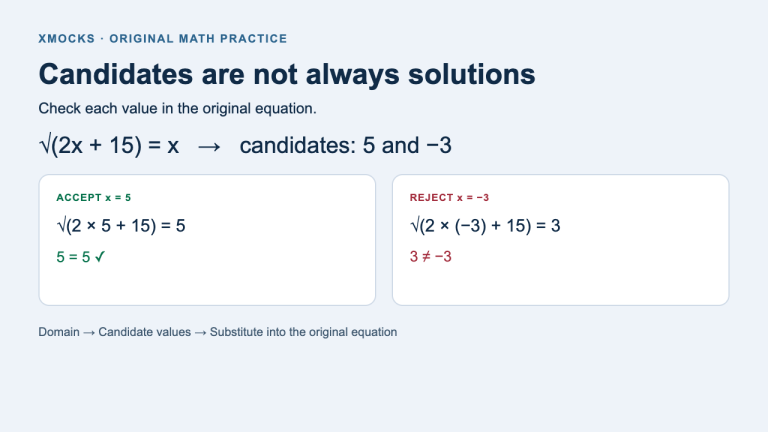
Make the task concrete. Suppose you solved 3(x − 2) = 2x + 5 by writing 3x − 2 = 2x + 5 and obtained x = 7. The error is distribution: multiplying the parentheses gives 3x − 6, so 3x − 6 = 2x + 5 leads to x = 11. Substitution checks it: 3(11 − 2) = 27 and 2(11) + 5 = 27. With x = 7, the original sides are 15 and 19, so it fails.
Turn that error into the next session: explain the distribution step, solve a fresh equation with parentheses, and check the answer in the original equation. Record the reason for the error and the repair. This gives your schedule a useful purpose beyond completing another set of questions.
Choose the next practice session
Pick one action you can complete this week: establish a baseline, review a recurring mistake, or test a repaired skill with new questions. Explore SAT and ACT practice on XMocks and inspect the available material’s topics and format before choosing a session. Keep the official practice resources available for rehearsing the relevant test experience, and revise your schedule as your needs change.